How to Use Host Cell Protein ELISA for Accurate Detection?
Accurate detection of host cell proteins (HCPs) is critical in biopharmaceutical development. HCPs can lead to unwanted immune responses, impacting the safety and efficacy of therapeutic products. Thus, employing host cell protein ELISA provides a highly sensitive method for quantifying these proteins. This technique enables researchers to identify and monitor residual HCPs throughout the production process.
In the world of biologics, understanding HCP levels is essential. Regulatory bodies stress the importance of robust analytics. Host cell protein ELISA plays a pivotal role in meeting these regulatory expectations. It helps ensure that drug formulations remain safe for patients. With various ELISA formats available, selecting the right one can be challenging. Each format offers unique benefits and limitations that researchers must navigate.
Despite its advantages, the host cell protein ELISA is not infallible. There can be variability in assay results due to various factors, including matrix effects and assay sensitivity. Continuous evaluation and optimization of the method are necessary to maintain accuracy. Integrating advanced technologies with ELISA could enhance precision in HCP detection, though challenges remain. Addressing these gaps is vital for advancing biopharmaceutical quality control.

Understanding Host Cell Proteins and Their Importance in Biotech
Host cell proteins (HCPs) play a crucial role in the biotechnology industry. These proteins can originate from the cells used to produce therapeutic proteins. Even in small amounts, HCPs can affect the safety and efficacy of biopharmaceuticals. Understanding their presence is essential for compliance with regulatory standards. They can provoke immune responses, leading to patient complications.
The challenge lies in accurately detecting HCPs during production processes. Host Cell Protein ELISA is a widely accepted method for quantifying these proteins. The technique is sensitive and can measure low levels of HCPs effectively. However, it's not foolproof. Analytical variations can result in misleading data. It's important to routinely validate test methods to ensure reliability and accuracy. Each assay must be carefully designed, considering both specificity and sensitivity.
Biotech professionals must stay informed about emerging detection technologies. Keeping pace with scientific advancements can enhance the robustness of HCP detection. Continuous improvement in methods is key to addressing the evolving regulatory landscape. While the quest for precise measurement is ongoing, these efforts ultimately contribute to safer biotech products.
Principles of ELISA: How It Detects Host Cell Proteins
The Enzyme-Linked Immunosorbent Assay (ELISA) is a widely adopted method for detecting host cell proteins (HCP) in biopharmaceuticals. Its sensitivity stems from an interaction between antigens and specific antibodies. According to industry reports, ELISA can detect HCP at concentrations as low as 1 ng/mL, making it crucial for ensuring drug safety and efficacy.
Understanding how ELISA works is essential. The assay employs a solid-phase binding of HCP to microplate wells. The addition of enzyme-labeled antibodies, specific to the target HCP, facilitates detection. When a substrate is added, the enzyme catalyzes a reaction, producing a measurable signal. Not all variations of ELISA provide equal reliability. Factors like pH and temperature can skew results. A misstep in sample preparation can lead to false negatives or positives.
Regular evaluation of ELISA protocols is necessary. Methods and reagents may change over time, affecting accuracy. Ensuring rigorous training and validation of procedures is vital. Data from the Biotechnology Innovation Organization indicates that up to 30% of biopharmaceuticals fail during development stages due to inadequate HCP management. Reflecting on these issues is critical for consistent and reliable results in future testing.
Step-by-Step Guide to Performing Host Cell Protein ELISA
The Host Cell Protein (HCP) ELISA method is essential for biopharmaceuticals. It quantitatively measures unwanted proteins from cell cultures. Accurate detection ensures product safety and efficacy, as HCP can cause adverse effects in patients. A well-validated ELISA test is vital for regulatory compliance.
To perform the HCP ELISA, start with sample preparation. Dilute test samples to a level suitable for the assay. It’s crucial to avoid variability in sample handling. Next, incubate with capture antibodies specific to the HCPs. Ensure proper temperature control, as fluctuations can alter results. Washing steps must be meticulous to reduce background noise.
Tips for effective HCP detection include frequently calibrating your equipment. Regular calibration minimizes systematic errors in your results. Additionally, run controls with every batch of samples. Controls provide a baseline for assessing assay performance. Remember, variations in reagents can impact outcomes. Always use fresh reagents and check expiration dates.
Data from the Biopharmaceutical Research Consortium indicates that 85% of biologics have HCP levels above acceptable limits without rigorous testing. This statistic highlights the importance of stringent HCP detection practices. The challenge remains in achieving consistency across different batches. Invest time in method development and optimization to tackle inconsistencies.
Host Cell Protein Detection Using ELISA
This bar chart illustrates the levels of different host cell proteins detected in samples using ELISA. The data represents the concentration of proteins measured in ng/mL for various organisms.
Interpreting Results: Analyzing Host Cell Protein Levels
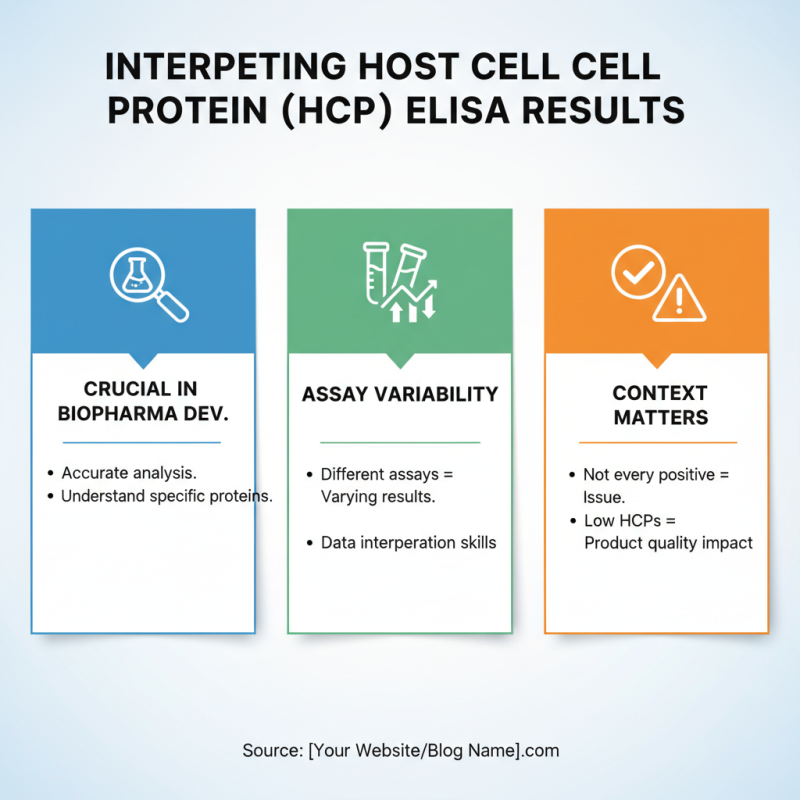
Interpreting results from Host Cell Protein (HCP) ELISA is crucial in biopharmaceutical development. Accurate analysis requires understanding specific proteins present in the sample. Different assays can yield varying results. This is where interpreting data skills come into play. Not every positive test indicates a significant issue. Sometimes, low levels of HCPs might not affect product quality.
When analyzing results, it's essential to consider the context. Factors like assay sensitivity and specificity can influence outcomes. Users should question results, especially if they show unexpected patterns. Examination of outliers is vital. These could indicate contamination or issues in the production process. Awareness of variability in HCP levels helps ensure stricter control measures are applied during production.
Moreover, correlating HCP levels with potential immunogenicity is key. Elevated HCP levels can trigger allergic reactions. Thus, thorough evaluation is necessary to mitigate risks. Maintaining a balance between sensitivity and accuracy is also a challenge. Not all variations in HCP levels signify concern, but vigilance is necessary. Adopting robust data interpretation practices ensures reliable results, ultimately safeguarding product safety.
Common Challenges and Best Practices in Host Cell Protein Detection
Host cell protein (HCP) detection is critical in biopharmaceutical development. Yet, many labs encounter challenges during this process. Variability in sample types can affect results. Method sensitivity may not be adequate for detecting low-abundance HCPs. Additionally, interference from high concentrations of therapeutic proteins can complicate data interpretation.
To enhance accuracy, consider these tips. Improvement starts with selecting high-quality reagents. This reduces background noise and increases signal clarity. Regular calibration of your assay equipment ensures consistent performance. Implementing standardized protocols can minimize variability between runs.
Another common challenge involves cross-reactivity. It’s essential to use specific antibodies that target a broad range of HCPs. Keep a close eye on assay conditions, as temperature shifts can affect binding efficiency. Finally, data analysis should include thorough statistical evaluation. This helps identify outliers and ensures reliable conclusions.
Striving for excellence requires constant refinement in methods and awareness of potential pitfalls.