
Advance Your Telomere Research Using ScienCell’s Absolute Telomere Length Quantification qPCR Kits!
Understanding Telomeres and Their Role in Genomic Stability
Telomeres are nucleoprotein structures that cap chromosome ends, protecting them from degradation and ensuring genomic stability. Each cell division results in telomere shortening, a process linked to aging and various diseases, including cancer, cardiovascular disease, and neurodegenerative disorders. Environmental factors such as stress, smoking, obesity, and high homocysteine levels can accelerate telomere attrition, making telomere length (TL) a crucial biomarker for health and disease research.
The Need for Accurate and Efficient TL Measurement
Researchers are increasingly interested in measuring TL to understand telomere maintenance mechanisms and the impact of lifestyle and dietary factors on telomere integrity. Several methods exist for TL measurement, including Terminal Restriction Fragment (TRF) analysis, Flow-FISH, quantitative FISH, and qPCR. qPCR offers a high-throughput, efficient solution that requires minimal DNA input, making it ideal for large-scale studies.
Guide: Quantifying Telomere Length — Southern Blotting vs. qPCR
Why Measure Telomeres?
Telomere length is a well-established biomarker of cellular aging, genomic stability, and disease progression. Accurate quantification is essential in fields spanning cancer biology, regenerative medicine, and age-related disease research.
Method 1: Southern Blotting (Telomere Restriction Fragment Analysis)
- Developed: 1980s
- Principle: Digests genomic DNA with restriction enzymes, separates fragments by electrophoresis, and hybridizes with a telomere-specific probe.
- Advantages:
- Historically considered the “gold standard.”
- Provides information on the distribution of telomere lengths, not just an average.
- Limitations:
- Requires large amounts of high-quality DNA (>3 µg).
- Time-consuming and labor-intensive (several days).
- Low throughput and difficult to scale.
- Overestimates telomere length due to inclusion of subtelomeric DNA.
Method 2: Quantitative PCR (qPCR)
- Introduced: Early 2000s (Cawthon, 2002)
- Principle: Measures telomeric repeat copy number relative to a single-copy reference gene (T/S ratio) by qPCR.
- Advantages:
- Requires nanogram quantities of gDNA.
- Fast and high-throughput — suitable for large sample sets.
- Adaptable to automation.
- Limitations:
- Sensitive to primer design challenges because of telomere repeat sequences.
- Results can be inconsistent without rigorous optimization and validation.
- Provides relative telomere length, not absolute fragment size.
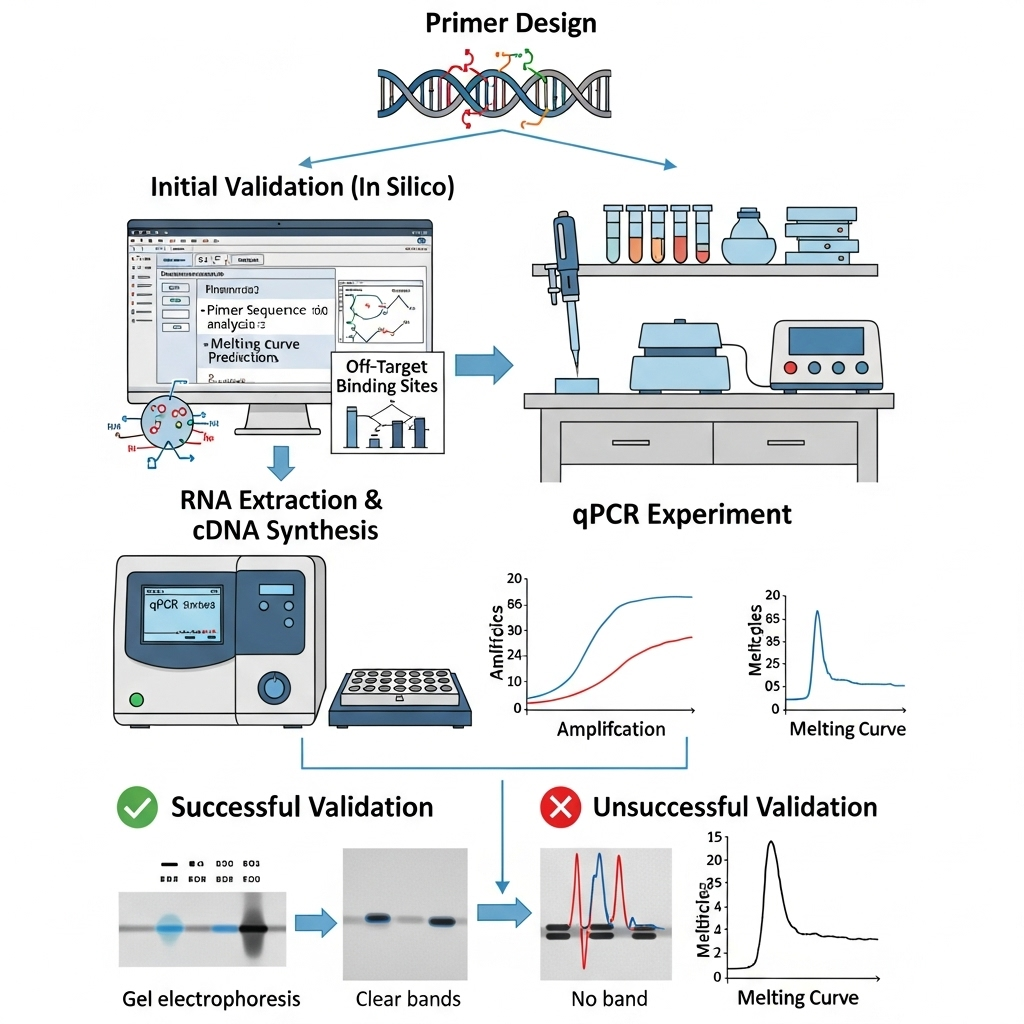
Key Challenge: qPCR Primer Validation
Due to the repetitive nature of telomeres, qPCR primers are prone to primer-dimer formation, which can compromise accuracy. Two criteria should always be verified:
- Primer Dimer Formation Test
- In a no-template control (NTC), no amplification should be detected before 28–30 cycles.
- Early amplification in the absence of template indicates primer-dimer issues.
- qPCR Efficiency
- Assess using a serial dilution of template DNA.
- Acceptable efficiency range: 90–110%.
- Outside this range → redesign primers or optimize assay conditions.
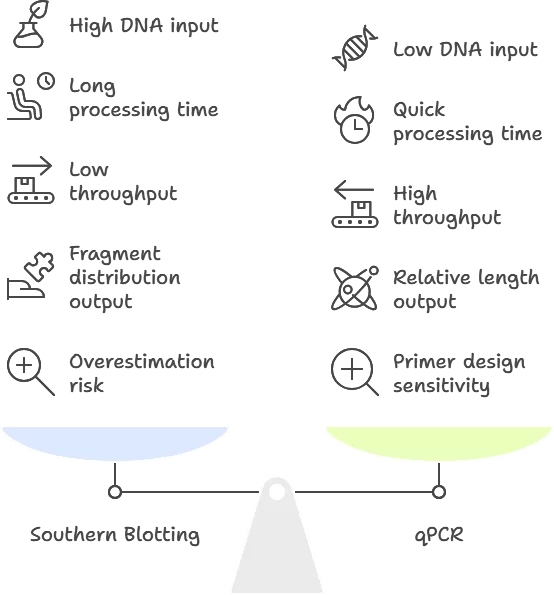
| Feature | Southern Blotting | qPCR |
|---|---|---|
| DNA input | ≥3 µg gDNA | ng-level gDNA |
| Time | Several days | 2–3 hours |
| Throughput | Low | High |
| Output | Fragment distribution | Relative length (T/S ratio) |
| Limitations | Overestimates, labor-intensive | Sensitive to primer design issues |
Conclusion
- Southern blotting is robust but outdated for most modern labs due to time and DNA requirements.
- qPCR offers speed, scalability, and low input needs, but demands validated primers to ensure reproducibility.
- For many researchers, optimized qPCR kits with validated primer sets provide the most practical balance of sensitivity, efficiency, and reliability.
ScienCell’s Absolute Telomere Length Quantification qPCR Assay Kits
ScienCell offers species-specific qPCR assay kits designed to provide a precise and reliable method for measuring average telomere length.
The kits include a reference gDNA sample with known telomere length.
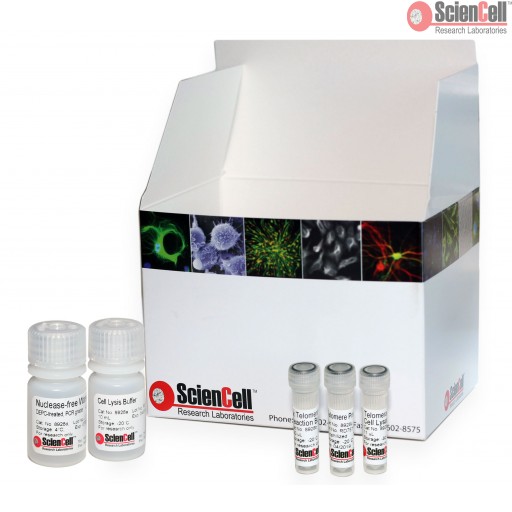
This kit can be used to calculate a sample's actual telomere length in kb.

Each kit features:
- High-Specificity Telomere Primers – Designed for efficient amplification of telomere sequences without non-specific amplification.
- Single Copy Reference (SCR) Primer Set – Targets a 100 bp region on a specific chromosome for accurate data normalization.
- Reference Genomic DNA – With a known telomere length to enable precise TL calculation of target samples.
- High-Throughput Capability – Optimized for large studies with minimal DNA requirements.
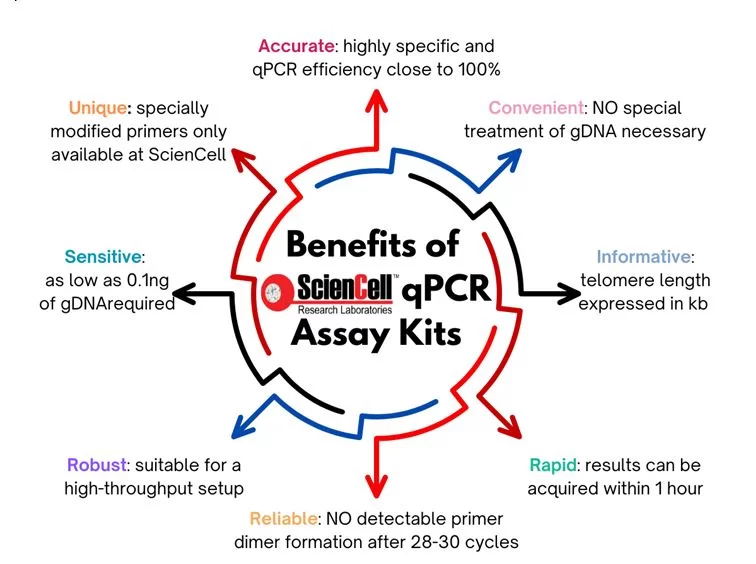
Why Choose ScienCell’s qPCR Assay Kits?
- Reliable Quantification – High efficiency primers ensure trustworthy TL measurement.
- Direct TL Measurement – Unlike relative TL assays, these kits provide absolute TL values.
- Optimized for Research – Supports investigations into aging, cancer biology, cardiovascular health, and lifestyle influences on telomere dynamics across multiple species.
Advance Your Telomere Research Today!
With ScienCell’s Telomere Length Quantification qPCR Assay Kits, researchers can obtain accurate, high-throughput telomere length measurements, driving new insights into cellular aging and disease progression. Enhance your studies with a trusted, efficient, and precise solution.